Thursday, September 12, 2013

New USDA APHIS Guidelines are Bullshit

*Disclaimer: I am going to try not to rant. I am going to try really, really hard not to rant. Sorry in advance if I end up ranting :).

On Tuesday, the USDA announced that APHIS (Animal and Plant Health Inspection Service) has revised the 'definition' of retail pet store in the Animal Welfare Act. Sounds good huh? The Humane Society of the United States (HSUS) has been pushing hard to crack down on puppy mills and regulate the internet sales of dogs. Great intentions, sure, but you know what they say about great intentions...well, here is our road to hell.

It Begins

So while HSUS has been telling the public this is to 'fix the puppy mill problem' the actual reality of this regulatory action is violating the Fourth Amendment rights of everyone with a dog and punishing good breeders or 'hobby breeders' who actually do things right. In government terms they are revising and updating the 'Retail Pet Store' rule or RIN 0579-AD57. But that actually affects more than you think, the government loves to sneak things in while you are focusing on a different point. Gawd, I hate politics. Let's review:
  • The definition of a retail pet store updated to state - A place of business or residence at which the seller, buyer, and the animal available for sale are physically present so that every  buyer may personally observe the animal prior to purchasing and/or taking custody of that animal after purchase, and where only certain animals are sold or offered for sale, at retail, for use as pets.
  • Ironically enough, actual pet stores are not required to be licensed and inspected under the AWA. Regardless of the fact that they are supplied by the puppy mills and have crappy living conditions, nice huh?
  • Also, if you have four or less breeding female dogs, cats, and/or small exotic or wild mammals on your premise than you are exempt from the licensing and inspection requirements.
  • But what do they define as a breeding female? Is there an age limit? Any guiding factors? Dr. Rushin (a Veterinary Medical Officer listed on the docket) had this to say - "We will determine a breeding female dog by our determination if its a breeding female. If we think it has a capacity to be bred, it's a breeding female." Great, so they are just going to make determinations on a whim. I love their determination skills. Maybe I just love the word determination. What I also find ridiculous is who says that the 'breeder' is breeding all of their females?? But the government says they COULD be bred so obviously that means that you WILL <inserting eye roll here>. Government says sorry you have 5 intact bitches, you have to comply, BAM. This alone will affect the small-scale breeders (think show, performance, etc.) who usually keep multiple intact bitches but don't breed multiple litters a year. Do you think these 'breeders' should have to keep their dogs under AWA regulations, which does not allow them to keep their dogs or whelp their litters in their homes? <see last bullet point>
  • Section 2146 of the AWA explicitly authorizes inspections of licensees to determine compliance with the AWA.
  • So this also subjects people's private homes to possible unannounced government inspections for AWA compliance. Hello, anyone heard of the Fourth Amendment?!? That whole unlawful search and seizure thing?!?
  • The AWA responds that such inspections are limited to only those areas that impact the well-being of the animals, such as areas where food and medicine for the animal are stored.
  • So how does raiding 'selected' parts of my house work? I'm pretty sure the Fourth Amendment covers the whole house. You certainly can't get to parts of my house where food and medicine are stored without going through other parts. Interesting tactic though.
  • There would also have to be compliance with 9 CFR part 3.
  • 9 CFR part 3 is an extremely long document detailing the conditions of proper housing. It's all rather sterile :). Anyways, in recap it requests you to not raise your litter in your nice house but rather move it a sterile concrete kennel with no furniture. But hey it'll have a nice floor drain and sprinkler system, that's what matters after all. Nevermind that a puppy's socialization period is between 3 and 8 weeks and they need to be exposed to as much LIFE as they can be so they won't be scared later. Nope, we'll just stick them in concrete kennels outside with limited human contact. How is that not a puppy mill again??

Those are what I deem the most interesting parts. There are plenty more and they deal with other animals besides dogs. So be in the know. Read the guidelines. Realize that what they say it covers and what it actually covers are two different things (since when is this new in politics??). All this bill does is slaughter small, responsible hobby breeders and pave the way for the puppy mills to own the market. Puppy mills are already paying these fees, so what is going to change for them? Nothing. They will still be able to sell puppies over the web and still have several hundred breeding dogs. Pet stores are getting supplied by puppy mills, what will change for them? Nothing, they are exempt. The details are scary people.

Has it occurred to you yet this is NOT making Internet sales illegal? (Which wasn't that the whole point of this revising issue?) Nope, it is simply requiring those breeders to be USDA licensed. It's not making puppy mills go away, it's only decimating the small-time dog fanciers who breed to actually improve their breed of dog. So if you want a puppy from a responsible breeder who raises their puppies in their home, sorry no luck. For those of you who enjoy having purebred dogs as part of the family, get ready to welcome a puppy mill lemon as your only option in the future.

Educate Yourself.

Over legislate much??

Please use the APHIS comment form and tell them how this is a poorly thought out rule.

Tuesday, September 10, 2013

Tuesday Training Tips: CGC Test Item 9

The ninth in my Canine Good Citizen (CGC) series going through each of the CGC exercises and offering tips for practicing in order to successfully pass a CGC Evaluation. Test Item 8 was covered previously.

Test Item 9: Reaction to Distractions

This test demonstrates that the dog is confident at all times when faced with common distracting situations. The evaluator will select only two of the following:
  1. A person using crutches, a wheelchair, or a walker (5-ft. away).
  2. A sudden opening or closing of a door.
  3. Dropping a pan, folded chair, etc. no closer than 5-ft. from the dog.
  4. A jogger running in front of the dog.
  5. A person pushing a cart or crate dolly passing no closer than 5-ft. away.
  6. A person on a bike no closer than 10-ft. away.
(Note: since some dogs are sensitive to sound and others to visual distractions, the examiner will usually choose one sound and one visual distraction).
The dog may express a natural interest and curiosity and/or appear slightly startled but should not panic, try to run away, show aggressiveness or bark. The handler may talk to the dog and encourage or praise it throughout the exercise.

This shows a walker being used and a crate dolly. Photo taken from Desert Dogs.

So Your Goal: To have your dog remain calm if a loud noise or visual distraction happens nearby.


Training Tips

Life is full of unexpected noises and your should be able to react calmly to most of them. Through exposure to everyday situations, your dog has probably learned to ignore the distractions generally used in this test. But, if your dog rarely sees a bicycle or has taken to barking and fence running when it sees a jogger, you may have some work in store. :)

The goal of this test is to determine if your dog is able to settle after an initial startle response, without bolting, barking, cowering, whimpering, or otherwise showing excessive fear. Acceptable startle behavior includes turning, backing up a step or two, sitting, moving slightly away without pulling you, or looking to you for direction. Each evaluator will have a different take on how much of a fear response is allowed so it never hurts to ask them what responses they would consider not passing if you are worried about your dog's response.

If your dog shows fear of unusual objects, sounds, or movements, you should help it by briefly exposing it to these things in a nonthreatening environment, and at a comfortable distance away from them. Praise, treats, toys, and playful interaction may eventually take its mind off fear and help it associate what was once frightening with positive experiences. As your dog becomes more confident, you can gradually bring the distractions closer.

When you feel like your dog can safely and successfully handle unusual objects, sounds, and movements, there are many ways to practice and prepare for the test:
  • Walk along busy streets to habituate them to all that traffic noise and motion.
  • Find a grocery cart in a parking lot and walk your dog around with it. Or try this with a stroller, moving dolly, or anything that's big on wheels. :)
  • Make some noise in the kitchen! Here's your excuse to bang on the pots and pans :). Start small and gradually build up the intensity of the banging.
  • You can always slam a few doors.
  • Make use of the driveway or garage floor to drop metal objects on.
Just remember to start your dog well away from the noise when it occurs first. Allow him to watch so he understands the noise is harmless. Your reaction needs to be negligible as well because if you respond with fear, your dog will too. All this practice takes time and actually this is stuff you should expose your dog to throughout its life, not just in preparation for the CGC test.

Next week we'll discuss CGC Test Item 10, Supervised Separation.


Don't forget to check out the other CGC test items we've covered:

Monday, September 9, 2013

Adventures in the kitchen - Peanut Butter Apple Biscotti Bites

Well I tried my hand at baking for the dogs again :). I had quite a run of successful recipes and I was feeling quite proud of myself. Almost proud enough to bake for humans! But I pulled out a new recipe to try the other day and well it just didn't work for me. I'm sure it was just user error on my part because as per usual, the recipe was from Doggie Dessert Chef and she makes everything look awesome :).

Please also note, these are gluten-free :).

Ingredients

1 Apple, cored and chopped
1/2 cup Peanut Butter
1/2 cup Milk
1 cup Soy Flour
1/4 cup Oats
1/2 teaspoon Baking Powder

Directions

1. Preheat oven to 400 degrees and line a baking sheet with parchment paper or a silicone baking mat. I used parchment paper.
2. Combine dry ingredients and stir until well mixed. Add apple, peanut butter, and milk to dry mix and knead until all ingredients are well combined.
3. Form dough into flat logs about 5 inches wide and 1 inch high. Bake on prepared baking sheet for 15-20 minutes. This is where I had problems. My dough was crumbly and I couldn't get it to form together, so I just went with it, LOL.
My version of 'logs' LOL.


4. Remove from oven and allow to cool for 10 minutes then cut logs into 1 x 1 inch squares. This also didn't work for me because mine were already falling apart so I just tore them into chunks. I'm sure the dogs didn't even know the difference ;).
Not quite pretty squares :)


5. Place squares back onto baking sheet and bake for 10 minutes, until the pieces are dry and crunchy (I decided to not to do this step either because well mine weren't gourmet material, I was also sure the dog's wouldn't care, and the oven was making the kitchen hot!). Cool and refrigerate.
Makes 1 to 2 dozen.

Rookie was still excited to sample the wares and didn't care how the cookie looked.
Oddly enough they smelled delicious, just like peanut butter cookies!

Do your dog's still love homemade cookies even when they don't turn out perfectly? What is your dog's favorite recipe? My dogs are always hungry for new things!!


Friday, September 6, 2013

AKC Responsible Dog Ownership Days

Hey look it's September! :) How did that happen so fast? Every September, the American Kennel Club (AKC) hosts Responsible Dog Ownership Days to bring to the forefront the responsibility it takes to have a canine companion. This hits especially close to home after hearing about two more Iowa towns that are looking at enacting Breed Specific Legislation (BSL) against Pit Bulls. This stuff seriously makes my head hurt (and well not to mention my heart!). If people were actually responsible owners, we wouldn't have such as thing as BSL.

There are many different ways you can 'celebrate' being a responsible owner:

  • Attend an event in your area. You can search the AKC's website HERE. There are many different kinds of events:
    • Breed parades
    • Obedience/agility/rally demonstrations
    • Microchip ID clinics
    • Health clinic/first aid for dogs
    • Therapy/SAR dog or Police K9 demonstrations
    • Free training classes with PAL presentations
    • Safety around dogs presentations for kids
    • etc. :)
  • If there isn't an event in your area, you can certainly host one by registering the event with the AKC HERE.
  • Sign the AKC Responsible Dog Owner Promise. You can go HERE to sign.


According to the AKC, last year more than 650 dog clubs and other organizations hosted events that reached millions of dog lovers and potential owners. That's a lot but it could certainly be more. There aren't any events in my area except the Des Moines Obedience and Training Club's show, which I don't think has anything special for Responsible Dog Ownership but it is a good place to go and talk to people about their breeds if you have questions.

I do hope you take advantage of whatever opportunities are in your area :). You can also check out the AKC's Facebook page and Twitter to see the latest posts regarding Responsible Dog Ownership Days.


Thursday, September 5, 2013

The Shedd Experience

This post has taken me a long time to write :), mostly because I don't even know where to start. The week at Shedd Aquarium covered so much that I probably have enough for a year's worth of posts! It's hard to figure out where to begin, what to cover, when to stop (because really I think I could go on forever, haha). So, with all that, I think I will start at the beginning, clever aren't I? :)

Shedd Aquarium in Chicago, Illinois. Photo from Wikipedia Commons.
The premise of this seminar was the basic foundation of Operant Conditioning and how the science of it applies to animal learning no matter what species you are working with. I got to see a lot of that in action!! We watched multiple training sessions each day that worked with several different animals in multiple ways - dogs, whales, dolphins, sea lions, sea otters, birds of prey, and lizards. The basic principles never changed, although sometimes the application did since obviously the animals are all very diverse :).


This is a video of Ken Rameriz working with one of the dolphins through the underwater viewing area's glass. The dolphin is receiving secondary reinforcers from Ken as feedback for performing cues correctly, and then he sends her to the surface to receive primary ones from another trainer in the actual dolphin enclosure.

Most of the training that Shedd Aquarium does is related to medical behaviors. It makes everyone's lives easier (animal, vet, and aquarist) if the animal willingly participates in medical procedures. Especially for the animal, as being restrained and forced into something is such a stressor and can have lasting negative impacts. This is something I walked away thinking about - what are some medical procedures my dogs can be trained to accept more easily? Obviously, nail trimming comes to mind because that is something that is performed often :).


Of course not everything they do is related to medical :). They have fun with their animals as well! A lot of the medical procedure cues are interspersed through the training sessions around fun cues that the animals like to perform. <hint, hint - think Premack Principle here!> Which brings me to something else I walked away thinking about - during their training sessions they go through many different behaviors even when teaching a new behavior. In reflection, at least from my perspective, in dog training when we want to teach a new behavior we mainly focus on that until we think they have it and then we start mingling other behaviors in. Which might increase the frustration and decrease the rate of learning. I am going to mull this one over and revamp some of my training sessions I think :).

Not everything was learning and work for us either, we broke up our 'training' (aka learning) sessions with moments of play as well :).

This is Tyler, a California Sea Lion, giving me a kiss :). We watched several training sessions with him and he was certainly one of my favorites. The other sea lion we worked with was Cruz, you can check out Cruz's story HERE.
Touching a stingray! These were much smaller than the ones
we swam with on our honeymoon but I was still excited :). 
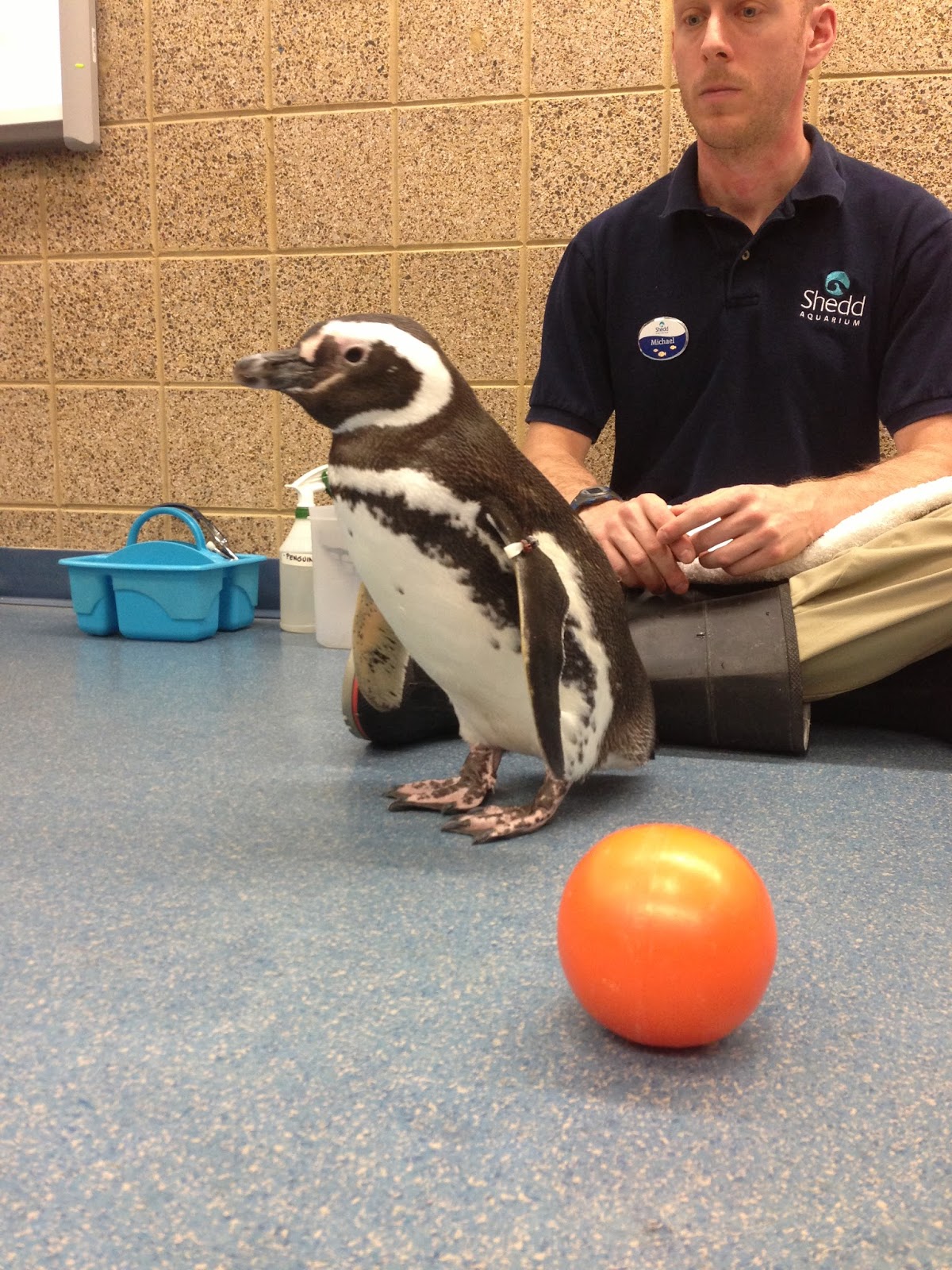
Olivia, a Magellanic Penguin, visited our lecture room for a quick break.
She was quite cute and loved sitting in laps!
And of course the dogs. Who could forget the dogs?!? :) We got to watch all three dogs in training sessions, I must say I quite loved all three of them! They will be up for adoption in a few months, some lucky families will get some incredible dogs!! I might have to keep my eye out for Dory ;).

Bruce is quite a cutie, you can read about his background story HERE.
Dory is very smart and quite accomplished already.
You can check out her story and Coral's story HERE.
I didn't have any pictures of Coral, but I did find a video! Here is Coral during one of their emergency recall training sessions.


The most amazing experience of all was the Beluga Encounter. I have enough to write about that to fill up its own blog post so you'll just have to wait in suspense until next week :). But before I leave you, here is a short video of a Taegu Lizard targeting. Obviously, with the primary reinforcer being baby mice you can only get so many repetitions in while training in the classroom environment :).


Training is so fascinating. I'm pretty sure I am a training nerd, lol. But I have had great experiences and met some very, very, very knowledgeable people through my learning quest :). At the Shedd Aquarium Ken Rameriz is the Executive Vice President of Animal Care and Training and he was our 'trainer' for the week long seminar. I have had the pleasure of hearing him speak at a different seminar as well and he will be at the Association of Pet Dog Trainers (APDT) conference this October so I look forward to seeing him again :).

Who are your favorite trainers to learn from?


Wednesday, September 4, 2013