Tuesday, September 24, 2013

Tuesday Training Tips: CGC Summary

This concludes my Canine Good Citizen (CGC) series on the preparation for each individual exercise and offering tips for practicing in order to successfully pass a CGC evaluation. Test Item 10 was covered previously.


A Few Final Resources

The AKC has a wonderful webpage with tons of resources on it detailing everything you could ever want to know about the CGC. A few things you'll find on that page:
  • Dog Owner Resources (covering everything you can think of)
  • Finding Evaluators and Classes
  • CGC Products
  • After CGC: What Can You Do Next?
  • Customer Service Contacts
The AKC also has the below video available for perusing :). Please keep in mind they produced this as an example of an IDEAL test.


A Few Final Thoughts

Keep in mind that the reason for taking this evaluation is to push yourself to help your dog be a better behaved, more enjoyable family companion. As you and your dog work together, you will discover a bond developing that will lead to a better relationship. The CGC accomplishment is often the first step to a wonderful relationship with your dog and to many fun dog activities. Good luck! :)

Keep the AKC's words in mind:
If you and your dog do not pass, it is not a failure but an indication of where you and your dog need more work.


Don't forget to check out the other CGC test item's we've covered:


Monday, September 23, 2013

Where did the weekend go?


...c'mon let's go hide from Monday over here! Maybe the rest of the week won't find us either and we can come out again on Saturday!!

Thursday, September 19, 2013

Dr. Ian Dunbar

Earlier this month I attended a seminar by Dr. Ian Dunbar in Iowa City and found it ... interesting. Especially considering I just went through a week-long, pretty intensive, seminar on Operant Conditioning at Shedd Aquarium. The differences were amazing and I have to say, I didn't agree with a lot of what Dunbar said.

Ian Dunbar with his dog Dune.
First, I was slightly irritated because his seminar was titled Common Sense and Cutting Edge Concepts, but nothing he covered was cutting edge. It was all pretty old school focusing on classical conditioning and seemed geared toward a pet owner with no training knowledge. I guess I was over qualified for his seminar :).

Second, almost everything he discussed revolved around puppies. Well, that doesn't really work in our world of rescues and shelters. We deal with adult dogs that already have baggage, not 'blank slate' puppies with owners that obviously care enough to put them in a puppy class to start with! Now I feel like I sound jaded and I hate that, but it's the reality for right now.

And lastly, he totally failed on his use of the science of learning terminology. For example, you can't change the definition of a primary reinforcer. I'm sorry but changing terminology to fit what you are talking about to a certain audience does that audience a disservice. Especially well-established terminology that is industry standard :). The correct terms for what he was talking about are conditioned reinforcers or secondary reinforcers. He also decided to rename a training technique to magically make it seem like it was something Sue Sternberg and him came up with. Um, sorry Dr. Dunbar the capturing/scanning training technique has been around for a long time, you didn't just invent it when you decided to call it "All or None" reward training. But nice try :). For someone not familiar with learning theory, they wouldn't even have noticed and that doesn't start them off on a very good foundation.

But lest you think it was a total bust, I did walk away thinking about a few things:

  • Emergency recall vs. Emergency sit/down: I like the idea of an emergency stationary position because sometimes it is also dangerous for them to try to get back to you. I will be investigating this idea :).
  • Condition (for emergency cues) that louder is better: We all know that when you get into an emergency and your adrenaline is flowing we tend to shout. Word just burst out at full volume and sometimes that can scare our dogs or make them think that we are angry with them. So this idea is to condition them to think that the louder the voice the better. The louder I yell a cue at you, the better the reward will be for listening. Interesting thought process.
  • Using problem behavior as a reward: Dogs express many problem behaviors because it feels good to them, so putting it on cue and then using it as a reward is interesting. Like barking - it can be very self-rewarding for dogs, so he says to put it on cue and then teach an incompatible behavior (like quiet). Then when your dog has performed something wonderful and it's appropriate for them to bark, you can give the bark cue and it will be self-rewarding. I have put bark on cue before (with Monday) but I have never used it as a reward. Again, an interesting thought.
Dr. Ian Dunbar is considered one of the most innovative trainers in the field. He has done a lot of impressive things - wrote 6 books on training, developed one of the earliest puppy training courses in the country, and in 1993 founded the Associate of Pet Dog trainers (APDT) whose mission is to promote better training through education - but I wonder if the times have caught up with him.

Well I can cross him off my 'seminar bucket list' :). You can always check him out on www.dogstardaily.com.


Tuesday, September 17, 2013

Tuesday Training Tips: CGC Test Item 10

The tenth is my Canine Good Citizen (CGC) series going through each of the CGC exercises and offering tips for practicing in order to successfully pass a CGC Evaluation. Test Item 9 was covered previously.


Test Item 10: Supervised Separation

This test demonstrates that a dog can be left with a trusted person, if necessary, and will maintain its training and good manners. Evaluators are encouraged to say something like, "Would you like for me to watch your dog?" You will give the leash to the evaluator and go out of sight for 3 minutes. You may tell your dog to stay if it already has a down or sit stay. The dog does not have to stay in position but it cannot continually bark, whine, or pace unnecessarily, or show anything stronger than mild agitation or nervousness. The evaluator is allowed to talk to the dog but should not engage in excessive talking, petting, or management attempts.

So Your Goal: To have your dog remain calm with a 'stranger' while you are out of sight.


Training Tips

This test does have some practical value. It comes into play anytime you leave your dog in another's care and you're out of the picture - grooming, doggie daycare, boarding, pet sitting, vet, etc. Even if you were out walking with a friend and decided to stop at a store for something - you would hand your dog's leash to your friend while you ran inside.

Many owners find it challenging to develop this skill with their dog. Most either have the confidence to handle it or don't :), but if your dog doesn't there are ways to help build it. Three minutes sounds like a short time, but when you are actually experiencing it, it starts to feel like quite a long wait! The easiest way to train this exercise is to have a helper who your dog knows well at first. The helper will hold your dog's leash while you go out of sight (mimicking the test). When you practice you want to make sure you gradually lengthen the time you leave the dog. Don't go too far away too fast or your dog will not be successful. Once your dog can handle separation for at least a minute, you want to make sure you start to vary the amount of time you are gone even as you build up to the full 3 minutes. That way your dog doesn't start to anticipate your return (we all know dogs can tell time!!).

Once your dog has been successful for 3 minutes with a helper they know, try it with a helper they don't know, but make sure you go back to shorter amounts of time. Don't assume because they can do 3 minutes with someone they know that they will be able to do 3 minutes with someone they don't know. Then once they can do the full 3 minutes with someone they don't know, take your practice on the road! Practice at new places so that your dog understands that this doesn't just happen at home, it can happen anywhere. When you start practicing at a new place, first use a helper that your dog is familiar with and start with shorter amounts of time, gradually building back up to 3 minutes. Then when they are successful in a new place with a familiar helper for the full 3 minutes, try it with someone unfamiliar going back to shorter amounts of time. When you change a variable (either familiar vs. unfamiliar helper or comfortable place vs. novel place) you want to make sure that you lighten your criteria (amount of time) so that they dog can still be successful.

You can practice for this test by yourself if you don't have access to a helper, but it's a bit more difficult. At first you want to work on your 'stay' cues - simply tell your dog to stay and walking a few feet away but standing with your back to your dog (so still in view at this point). Taking away the eye contact can be similar to going to out of sight for some dogs. Then when your dog can handle that, tell them to stay and go around a corner so then you are out of sight, but use a long line so that your dog is still safe if they break their stay position (and this will allow you to be able to tell if they have moved). Then practice that by gradually building up the amount of time that you leave them in their stay. A dog with a solid stay will generally hold that position for the 3 minutes and many dogs are comfortable being left with a cue that they are familiar with. The 'holder' at the test will be an unknown variable, but if your dog has a solid stay they shouldn't be bothered by them.

Next week I'll return with a few overall tips for preparing for test day along with some resources that are helpful for taking the CGC test.


Don't forget to check out the other CGC test item's we've covered:


Monday, September 16, 2013

Backyard Acrobatics

Last week Monday ripped almost the entire pad off one of her back toes. It was obviously very painful as she hasn't been putting any weight on that leg for the last week. So imagine my surprise when we are outside for a potty break after dinner and I find this:


Gee, sure doesn't look like her foot hurts huh? It's amazing what a little arousal and adrenaline can do :). It's why whenever you take your injured dog to the vet, all the sudden nothing is wrong and the vet can't get a pain response. Little boogers :).

Do your dogs 'forget' about injuries when they are excited? 


Friday, September 13, 2013

Beluga Encounter

While I was at the Shedd Aquarium, I got to experience pretty much the best thing EVER - getting in the water with a Beluga whale. It was awesome and amazing, and actually pretty indescribable. Although, I'll try to describe it for you here and now :).

The Belugas!

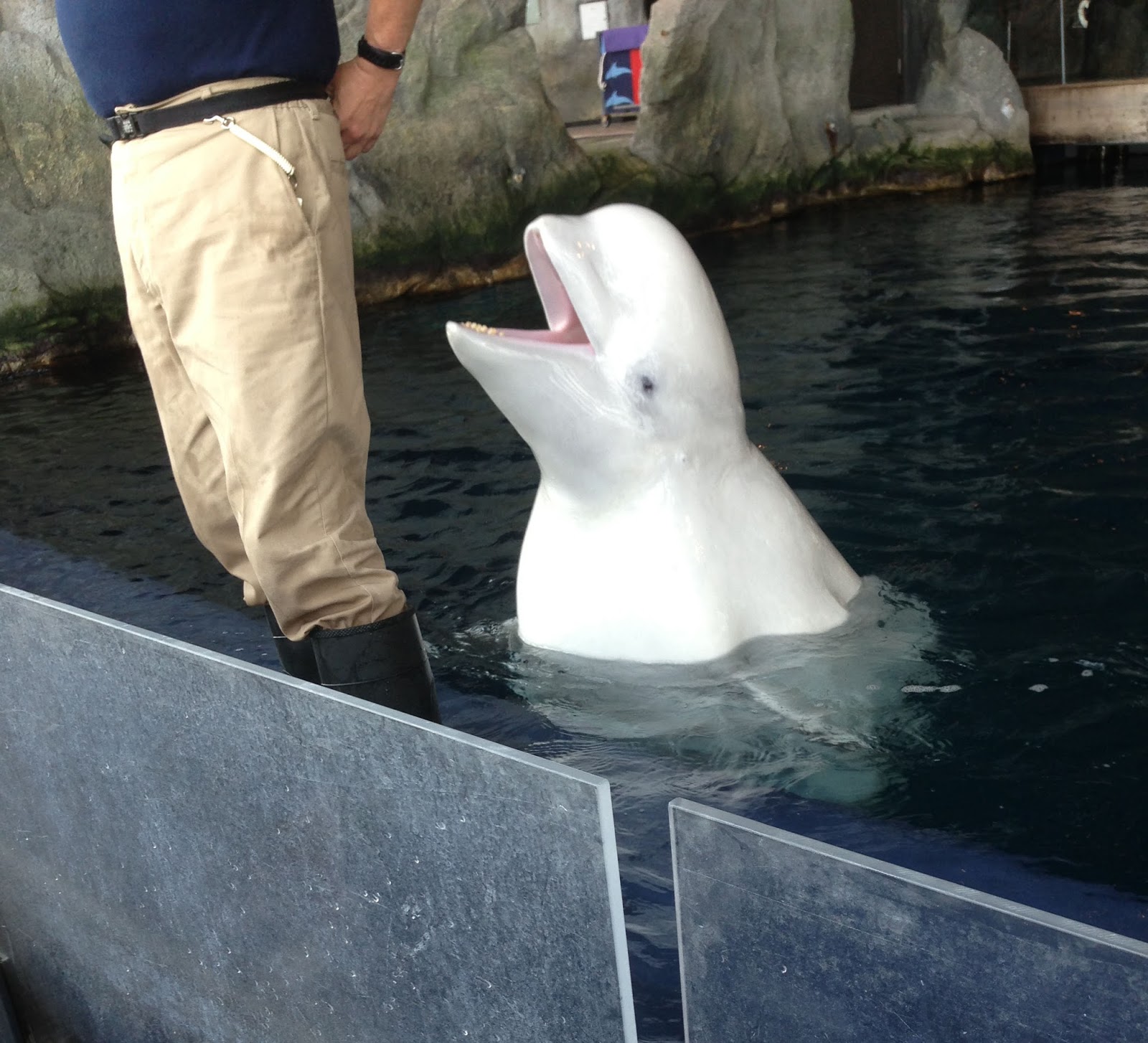
These whales look happy ALL THE TIME, they have these soft, squinty eyes and big smiling mouths. Uber-cute! I don't think they ever have a bad day. Every time you look at them, you can't help but smile in return. Instant bad day fix right here.

See, don't they look happy??
Belugas (also called 'white whales') are actually one of the smallest species of whales, ranging from 13 to 20 feet long. Their white coloring and prominent foreheads make them easily identifiable, which totally works for me as I have a hard time describing things. This is easy - they are that small, white whale with a giant forehead :). And they don't have a dorsal fin - no mistaking them for sharks!

Belugas generally live together in small pods and the ones at the Shedd Aquarium are no exception. They have 5 Beluga whales that live together. And get this - their average life span in the wild is 35 to 50 years. That just seems like a long time (even though I know we humans live longer), maybe because I am comparing it to dogs who only live like 15 years. Belugas are social animals and love to play. I swear these guys have a sense of humor :).

Doesn't it look like he is going to bite Ken's butt??? :)

Fun Fact: Unlike most other whales, the beluga has a flexible neck that enables it to turn its head in all directions.

Think the exorcist, haha :). 

The Encounter

Duhn duhn duhn - oh wait that's for sharks. I guess there isn't one for whales *shrugging shoulders*. All joking aside, these whales are pretty big and still dangerous, even though they are 'small' in the whale world. But I still donned on waders (and I mean waders) and climbed down into the Beluga whale habitat. The water was COLD (which I guess make sense since the whales live by the Artic, LOL) but still I wasn't quite expecting that. Luckily our waders were dry suits so I was completely dry and moderately warm underneath.

The first order of business was to let the whale get introduced to us and say hello. Not like you can shake hands and exchange greetings, but he swam down the line of us (there were 4 of us and 1 trainer per whale) and checked us out.

*Disclaimer: You'll have to excuse the quality of these photos as they were taking on my iphone by someone obviously not familiar with an iphone camera :). 
Checking us out and making sure we were of the friendly sort :).

Then we each fed the whale to further establish a rapport. Their primary reinforcers are fish (obviously!) and then we used secondary reinforcers of tongue tickling, clapping, and splashing water in their face (yes they do love this).

I actually didn't mind holding the fish. It wasn't as gross as I thought.
The first time we fed them, we put the fish directly in his mouth.
The second time, we had him suck it from our hand underwater. That felt really cool!
Then we got down to business and we got to cue them for behaviors. The trainer had the whale lay out in front of us and present us with his side so that we could all touch him. They feel pretty cool, it's really hard to describe but they are softer than you think :).

Touching the Beluga whale.
Feeling their 'bump'. It's like an extremely large muscle
and they can actually move it around quite a bit
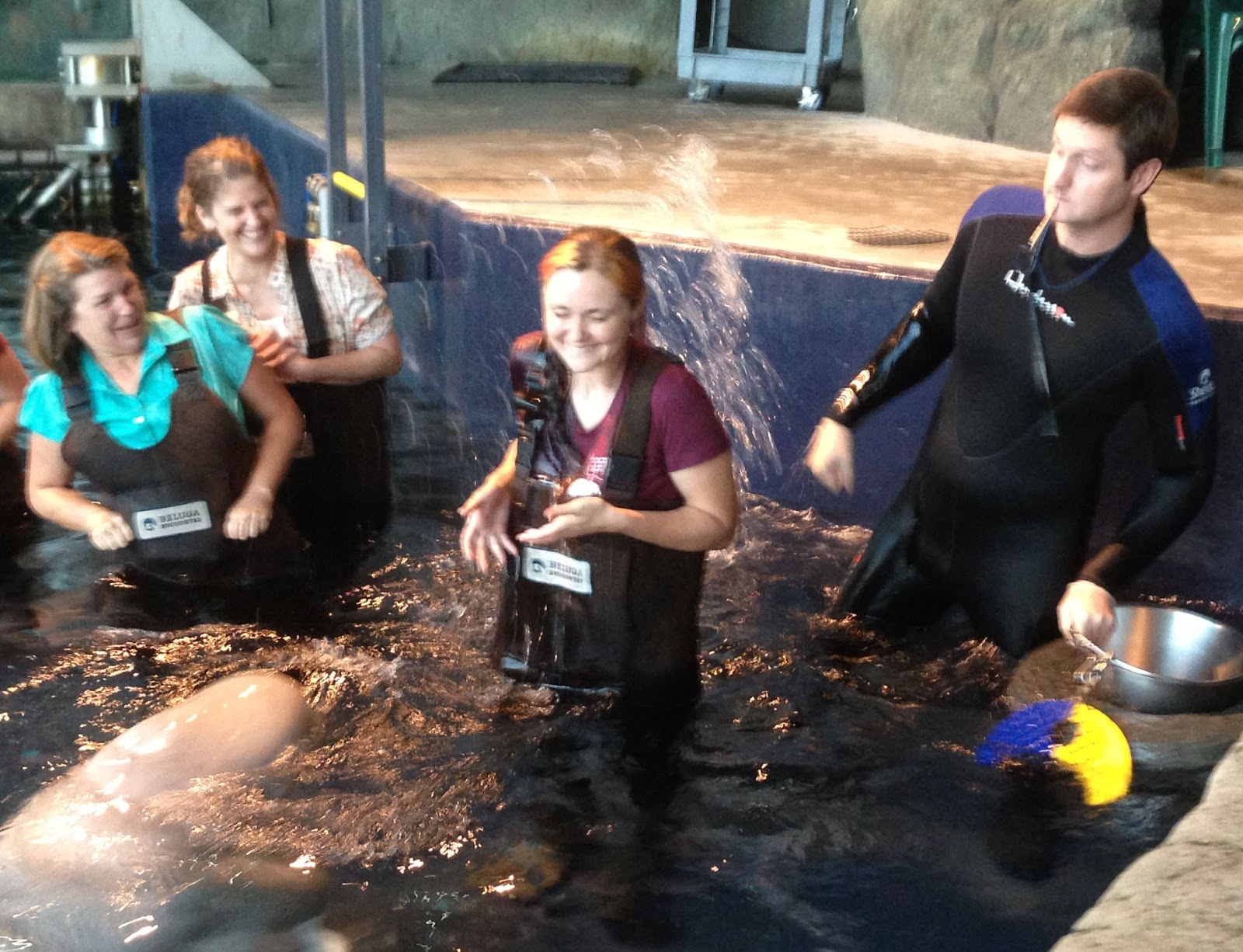
Then we got to ask for behaviors! The best part :). We asked for hand targets, for blowing on your hand underwater, for a kiss, for a head bump (putting your forehead against theirs), and for him to spit on us. Yes, we asked a whale to spit water on us. I couldn't say no, because really how often are you going to get a chance to have a whale spit on you?!? Beluga's like to spit water so the trainers had to put it on cue so that they could extinguish it and keep it from happening when they weren't expecting it :). Like I said, I'm sure the whales have a sense of humor!

Blowing on my hand underwater.
Hand targeting.
Kissing :)
He's spitting on me. It was so cold!!!
More spitting :)
I really, really liked tickling their tongue. I don't know why, but it was pretty cool. Their tongues are much softer than you would think, kind of like a dog's tongue as opposed to cats.

Tickling the tongue!!! :)

The Take Away

I want a whale. I am pretty sure I could fit a baby one in the bath tub. :) Okay okay, maybe that won't work but it can still be a dream of mine! 

It was really interesting to see how well the whales responded to each of our cues even though they weren't familiar with us and didn't have any kind of bond with us. Yes the real trainer was right there with the whistle and food, but we were still the ones giving the hand signals and asking for the behavior. Plus, while we made every effort to give the hand signals exactly like the trainer shows us, I'm sure there was a lot of variance looking at it from the whale's perspective. They still performed regardless, which tells us that they really, really know what each of those cues means. There wasn't any hesitation and there weren't any wrong responses. It was quite nice to see how confidently they did each behavior and how eager they were to do the next behavior. That's what needs to happen more in dog training!!

More Belugas Please

Here are a few videos from one of the training sessions with an experienced trainer. I really enjoyed these sessions and seeing what some of the 'fun' behaviors entail. The whale looks happy and eager the whole session and seems to really love to interact with the trainer. It looks like a play session :).


What do you think? Do you think your dog's training session looks as fun as these sessions? Does your dog look as happy as the whales?